Friday, 3 May 2024

João Baptista Darin Filho, 1944 appointment book

I started visiting Marília-SP in the early 1990s, when I was 44 years old. Although I was born there in May 1949, I left town with my family in December 1960, when I was 11 years old, and never looked back except for a few quick visits while I was in my teens. 

By 1993, when I visited Marília for more than a few days, most of my Darin uncles & aunts had already died. My Mother's sister Rosa Darin (1915-1996) and sister-in-law Maria da Gloria Redondo Batista (1931-2021) were the only ones still alive. I still had quite a few cousins alive then but the earlier generation was basically gone. 

When I visited Marília, I usually stayed at aunt Rosa's little house built in the back of a larger one at Rua 9 de Julho, 2008, in which João Baptista Darin Filho & family lived since they moved out of Rua Campos Salles, 350, a couple of years after my grandfather Marco Giovanni Battista Da Rin Zoldan died in August 1959. 

Rosa Darin (1915) was only 4 years younger than João Baptista Darin Filho (1911). They lived together their whole life for Rosa never married and João married late in life (37). When João finally married he went on living with his father & sister; he only brought the wife in to live with them. Rosa was the family 'archivist'. She kept family mementos which other people would've chucked out. That was my luck. 

Here's a little 1944 Appointment Book (day-book) which belonged to João Baptista. It is amazing what one can surmise reading these little notes João wrote during part of 1944. 

João must've got this little appointment book for 1944, from his friend Eikichi Kaneno. João lived on Rua Campos Salles, 350 and worked as a mechanic and truck driver at Fábrica de Cigarros Sudan S.A., on Avenida 10 de Novembro, 859. João wore shoes size 38, weighed 62 kg and stood 1.70 metres tall. 
João Darin Filho was born on 18 April 1911, so he was 32 years old when 1944 started. He was the last Darin male child left at home with his father Marco Giovanni (72) and sister Rosa (28). João could be described as a melancholic person (sanguine, choleric & phlegmatic are the other 3 kinds). See his first entry in the little book: 'I started 1944 very bad. What a weight!' (Comecei o ano de 1944 muito mal. Que peso.) João's spelling was not really good. He had had only elementary education at the rural property owned by his Father in São José do Rio Pardo, before moving to Marília, when he was 16 years old
His 2nd entry on Thurs, 10 Feb 1944, is not much different: 'Estou de azar. Entrei o ano de 44, com o pé esquerdo' ('Bad luck. I started '44 with the left foot'. 
17 February 1944, Thursday: 'I had lunch at Pompéia-SP.' (Almocei em Pompéia); Friday, 18: 'Passei em Vila Fortuna' (I passed through Vila Fortuna); Saturday, 19: 'Cheguei de viagem de Bela Vista'. (I have just arrived from Bela Vista). 
20 February 1944, Sunday (Carnaval): 'Chuva. Fui ao cinema'.) (It rained, I went to the movies.); Monday, 21st: 'Carnaval péssimo. Fui ao cinema'. (Carnaval festivities were bad. I went to the movies.); Fat Tuesday, 22nd: (Destination: Lucélia-SP; the road was impassable.) (Destino: Lucélia. Estrada intransitavel.); Ash Wednesady, 23rd: 'Passei em Quintana'. (I went through Quintana-SP). 
24 February 1944, Thursday: (I had lunch in Quintana-SP) (Almocei em Quintana); Friday, 25: 'Saída para Tupã-SP; muita chuva; destino: Lucélia.) (I left for Tupã; a lot of rain; destination: Lucélia.); Saturday, 26: 'Cheguei em ... (unclear handwriting); não tinha quarto.) (I arrived at ...there was no room at the hotel.) 'Almocei em ...).
27 February 1944, Sunday: ('Passei o domingo em casa. Muito mal'.) (I spent Sunday at home. Too bad.)
28 February 1944, Monday: 'Viajei para Garça-SP. Almocei em Vera Cruz-SP; Posei em Garça'. (Traveled to Garça; had lunch in Vera Cruz; I stayed overnight in Garça.) Corinthians x Flamengo (two football teams). João probably listened to the match broadcasting on the radio of his truck; 29 February 1944, Tuesday: 'Destination Gallia; had lunch in Gallia; stay overnight in Gallia; 1st of March 1944, Wednesday: Destination: Marília. 
2nd March 1944, Thursday - João, candidly says, he spent some time at a whorehouse (zona) in Garça-SP; Friday, 3rd: I paid for the fixing of my watch (Conserto relógio, pago).
5 March 1944, Sunday: 'I started getting 560.000 a monthly in 1944. It's too little' (Em 44, passei a ganhar 560.000 réis. Muito pouco'. 
13 March 1947 (apparently 3 years later) João writes: 'Segui para São Paulo para tratar saúde'. (I went to São Paulo in order for health reasons.) João doesn't explain what kind of ailment he had or why he wrote the note 3 years later.
15 March 1944, Wednesday - Taça Cidade de São Paulo: Corinthians F.C. 2 x São Paulo Football Club 3; João must have been happy for he 'rooted' for Corinthians F.C. 
16 March 1944, Thursday - 'Troquei o relógio; CrS 300.00. (I changed my watch.) Confusing statement. João probably wanted to say, he either exchanged his watch for another one or most likely he bought a new watch and paid Cr$ 300.00 for it. Now, things get more confusing still for Brazilians were introduced to a new currency named Cruzeiro Cr$ on 5 October 1942. It usually took a few years for people to get used to the new currency...maybe that's why João kept on writing Real symbols instead of the new Cr$ one. 
9 April 1944, Easter Sunday - 'A maior surpresa do ano: Corinthians 1 x Jabaquara 2'. João's favourite football team lost to Jabaquara. 
10 April 1944, Monday - 'Quebrei o meu relógio. Que azar.' (My watch broke. What bad luck.)
12 April 1944, Wednesday - 'Fiquei doente.' (I got sick). Not much information about what kind of sickness João came down with. 
13 April 1944, Thursday: 'Idem.' (The same; João was still sick).
14 April 1944, Friday: 'Idem. Um pouco melhor.' (Still sick, but a little better.)
15 April 1944, Saturday: 'Não viajei.' (I have not traveled.) Things get more confusing for João writes the word 'Junho' (June) below 'Saturday, 15). Now, we don't have means to know whether it is April or June
6 August 1944, Sunday - After 4 months with no entry at all, João Baptista shows a new vigour in his hand, writing with block letters: 'Hoje, domingo, 6 de agosto, um dia de pouca alegria para mim. Pensei muito, mas não resolvi nada.' (Sunday, 6 August, a day with little joy for me. I thought a lot, but have come to no conclusion.). God only knows what kind of thoughts João had on the Sunday. 
8 August 1944, Tuesday: 'A maior surpresa do ano: Palmeiras 1 x São Bento 2.' 
13 August 1944, Sunday: 'Irei jogar bola.' (I will play football.' It's surprising to know João could actually play football and not only listen to match broadcasts.
3rd September 1944, Sunday: 'Cortei o cabelo bem curto.' (I had my hair cut very short.)
4 September 1944, Monday: 'Aniversário do Francisco José. Completou 4 anos'. (Francisco José's birthday. He was 4 years old.' We don't know who Francisco José might be. Not a relative for sure. Could be some friend's child. 
1st October 1944, Sunday: 'Fui à Missa.' (I went to Mass.) Darin Family was very religious but João Baptista in particular was not really a regular Mass goer. 
2nd October 1944, Monday: 'Mandei fazer uma blusa.' (I ordered a blouse to be made.) One doesn't know what kind of 'blouse' João ordered. Or who took the order. 
7 October 1944, Saturday: 'Fui ao cinema'. (I went to the movies). João could have go to either Cine São Luiz, on Rua 9 de Julho, or Cine Marília, which was only 3 blocks away from his house. 
2nd November 1944, Thursday (Day of the Dear Departed): 'Finados. Dia muito chuvoso. Bem inferior ao do ano passado. Passei o dia bem triste, um pouco adoentado'. (A rainy day. Inferior to Departed Days of 1943. I was sad most of the time. A little under the weather.' We may only speculate what was João's reason for being sad the whole day. He probably thought about his Mother, Erminia Billò, who died 10 years before. Apparently, he was very attached to her; he was 23 when she died on 25 May 1934
6 November 1944, Monday: 'Comecei gozar férias contra a minha vontade'. (I started my annual vacation against my will'. 
7 November 1944, Tuesday: 'Não saí de casa'. (I stayed home.)
8 November 1944, Wednesday: 'Idem'. (Ditto.).
15 November 1944, Wednesday (National holiday): 'Fui pescar. Peguei...' (I went fishing...). João maybe intended to keep on writing about his fishing... but lost courage half-way the first word. 
18 November 1944, Saturday: 'Hoje, sábado 18, ainda estou na mesma. Nada resolvido'. 
24 November 1944, Friday: 'Vou entrar em serviço. Acabaram as minhas férias bestas. (I'm going back to work. My foolish vacations are through.)
March 1944 - Cash Account - Figures indicate João borrowed money from his friend Mioshi, and was paying him back bit by bit. He still owed Mioshi 50.00 whatever currency it may have been. 
February 1944 - Cash Account - 'Falta um motorista. Comecei a viajar em 28 February (Zona de Garça) até 1o. de Julho; depois viajei outra vez'. (We're short of one driver. I started driving on 28 February (Whorehouse in Garça) until 1st of July; then I traveled again'. 
September 1944 - Cash Account - 'Mioshi. Mandei fazer um terno, dei Cr$ 200.00 cruzeiros'. João writes Mioshi's name but then changes subject: 'I ordered a suit. I gave 200 cruzeiros instalment'. 
Addresses & telephones: 'Fábrica de Cigarros Sudan S.A. Avenida 10 de Novembro, 867, phone: 3260'. 
Addresses & telephones: João Batista Darin Filho, Rua Campos Salles, 350; phone: there is none.
João Baptista Darin Filho with a mate on a Sunday afternoon romp at a bar. As one can see João knew how to laugh and have a good time. He must have been in his late 20s or early 30s, probably 1944, the year he wrote about himself in his appointment book. 

The impression one gets after reading João's day-book is of someone who's a loner. There is something that bothers him. He feels he needs to take some action or change something in his life but he doesn't say what it is. Apart from Mioshi's name, João seems not to relate to anyone; at least he doesn't write names of people, apart from the 4th birthday of a boy named Francisco José, whose relationship with him remains a mystery. 

João, surprisingly writes about visiting a whorehouse in Garça twice. But he doesn't expatiate about it. He seldom writes about his feelings except to complain about 'having to go on vacation against his will' or contrast this year's Finados (Day of the Departed was not as good as 1943's) with last year's.

João also seemed to be sick many a time. At one time he had to travel all the way to São Paulo to get treatment of a disease that remains unknown. Apparently, listening to football broadcasts on the radio and going to the movies were João's only pleasures in life. He also mentioned (only once) he would go out to play football (with friends, I suppose).

When I reach for the past for a glimpse on João Baptista Darin Filho's personality I don't come to any conclusion. I met him many times before I was 12 years old for he lived in the same house as my Grandfather's and aunt Rosa's. At first I thought he was mopey & gloomy but that may not have been the truth. If you look at some of his photos you know he had a bright jovial side too but he behaved in a very low-keyed way when I saw him as a child.

João ended up marrying a woman with an opposite personality to his own. Maria da Gloria Redondo was an outgoing and sociable person. They say opposites attract each other... then that must have been a marriage made in heaven. They got married on 13 October 1949, some 5 years after João wrote this day-book.

I once asked Maria Redondo why Marco Giovanni Darin sold his farm (Fazenda Apparecidinha) in São José do Rio Pardo and moved to Marília in November of 1927, and what she told me was almost unbelievable. 

In the mid-1920s Marco Giovanni Darin leased part of Fazenda N.S.Apparecida do Rio Verde to a Black man who tilled the land and planted coffee beans. After harvesting was done and the crop was sold, Mr Darin would collect the rent as usual. Something happened that particular year and the man failed to pay the rent. When it came to collect next year's rent, Mr Darin went to the man's house and while he was there the man had a heart attack and died. Some of the man's friends blamed Mr Darin for his death and bad blood set in. Life at the farm was not the same anymore with recriminations and threats flying around.

Just at this juncture (circa 1925), João Baptista who was 14 years old fell ill after eating a fruit everyone thought it was poisoned. The boy started having seizures similar to those afflicted by epilepsy which alarmed Marco Giovanni a great deal. Father took his son to be examined by doctors in the city but nothing came of it. Some said João had been the victim of witchcraft from those who blamed his father for their friend's death. We don't know details about the case but it was reported that once João vomited a ball of hair

Marco Giovanni was a deep Catholic man but he must have been superstitious too. Besides, Marco was 54 years old and probably tired of the hard work he had to put up in that farm. He had six sons: Rissieri (26) already married to Elisa Surian (32) since 16 June 1924, who was Apparecidinha's elementary teacher; Jácomo (25) about to marry his cousin Maria Corsini (20), Luizinho (20), Octavio (16), João Baptista (14) and Valdemar (4) but no one seemed to be interested in working hard.

In other words, Marco Giovanni was deeply unhappy. He saw the solution to all his woes would be to move away from it all; sell his property and with the money go west to Marília, where they said the streets were paved with gold. That's what happened in a nut shell. The sons and daughters: Maria (23) already married since 27 September 1923, to Gumercindo Dutra (31), Apparecidinha's milk man, Angela (21), America (18), Nina (12), Rosa (10) and Yolanda (6) would soon know a new life in town. 

All the children who were 10 or older rejoiced in the idea of leaving the farm they all had been born in and move to a town filled with excitement. Less than 2 years after, on 15 November 1927, the whole family took a train to Campinas-SP and from there another train that took them to the end of the railway line Garça, where they alighted and took a bus to Marília which was only a village by then.  


Monday, 15 April 2024

Fazenda N.S. d' Apparecida do Rio Verde, in São José do Rio Pardo-SP


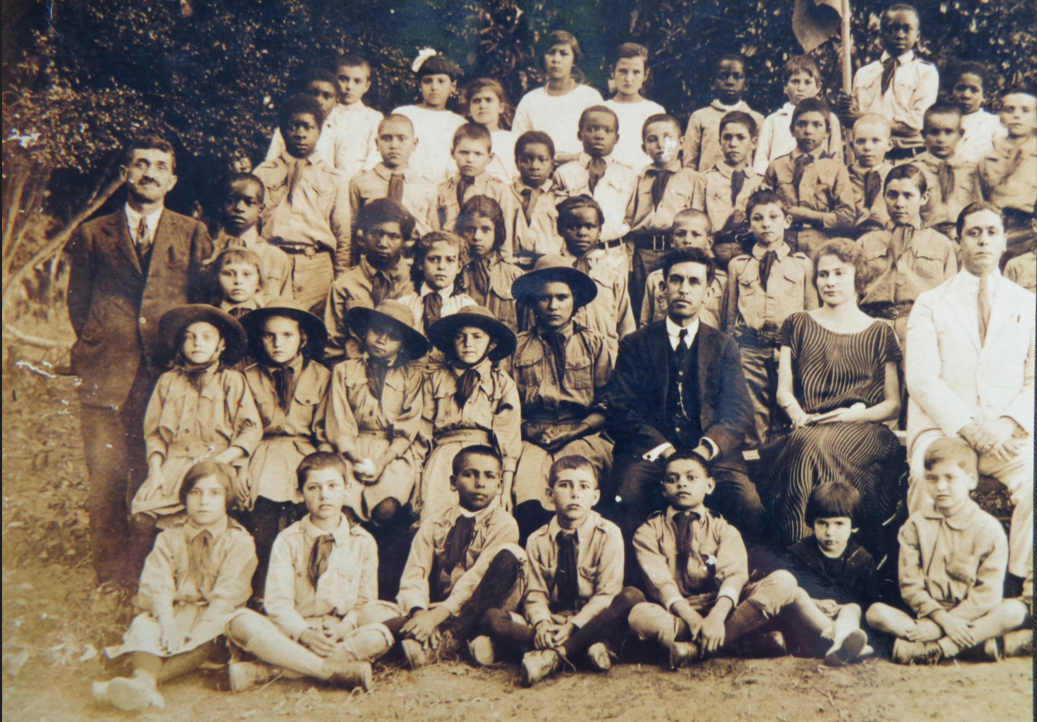
13 May 1924, Tuesday - 68 children comprised the whole school at Fazenda Nossa Senhora d' Apparecida do Rio Verde, owned by my Grandfather Marco Giovanni Battista, who is the man standing up on the far left of the picture. Among the children there are at least 4 of João Baptista's children who will be identified further down. Elisa Surian, the elementary teacher in the centre, would marry Rissieri Darin, the heir of the property, 9 weeks later, on 16 July 1924.
Left-side.
Right-side. 
João Baptista Darin Filho (13) is the boy in the middle of the left-side photo; on the right-side one can see Octavio Darin (15) & Olympia Darin aka Nina (10).
Marco Giovanni Battista Da Rin Zoldan (52) aka João Baptista Darin, owner of the Farm and father of Rosa Darin (9) the hatted-girl looking at the camera on the right-side. 
on the left, Victoriano Romano, school inspector; at centre Elisa Surian, teacher; on the right Julio de Faria e Souza, teacher & regional deputy of teaching. Note that Elisa Surian would marry Rissieri Darin, Mr Darin's oldest son on 16 July 2024, less than 2 weeks after this photograph was taken. 

Looking at this photo taken on 13 May 1924, on the grounds of Fazenda Nossa Senhora d' Apparecida do Rio Verde, which was owned by my grandfather Marco Giovanni Battista Da Rin Zoldan some one hundred years ago - for today's date is 5 May 2024 - it's hard to understand that three and a half years later, on 15 November 1927, the Darin Clan would leave the area of São José do Rio Pardo and move to Alto Cafezal, which 2 years later would become a municipality called Marília

The distance between São José and Marília in a straight line amounts to 376 km, but in 1927, one would have to take a train to Campinas, then take another train to Baurú, and yet another one to Garça, which was the end of the railway line. It amounted to almost 700 km. It probably took 48 hours or more. 

But before we fix our attention on the trip itself let's go back to 13 May 1924, the day this photo was taken. 

I visited Marília on 13 February 1997, a Thursday, and had a long conversation with Maria da Gloria Redondo, widow of João Baptista Darin Filho, the last surviving member of the Darin family apart from my own Mother who would die in 2006. As Maria Redondo had lived in the same house as my Grandfather, for the last 10 years of his life, she had the chance to talk to him more often than his own flesh and blood. 

Maria had a veneration for the old man even 38 years after his death, and better still, she had a clear vision of what had happened in the past and could tell details that would've slipped the attention of other people. I asked Maria Redondo why Marco Giovanni Darin had sold his farm in the Mogiana trunk line and moved to Marília in November of 1927, and what she told me was almost unbelievable. 

In the mid-1920s Marco Giovanni Darin leased part of Fazenda N.S.Apparecida do Rio Verde to a Black man who tilled the land and planted coffee beans. After harvesting was done and the crop was sold, Mr Darin would collect the rent as usual. Something happened that particular year and the man failed to pay the rent. When it came to collect next year's rent, Mr Darin went to the man's house and while he was there the man had a heart attack and died. Some of the man's friends blamed Mr Darin for his death and bad blood set in. Life at the farm was not the same anymore with recriminations and threats flying around.

Just at this juncture (circa 1925), João Baptista who was 14 years old fell ill after eating a fruit everyone thought it was poisoned. The boy started having seizures similar to those afflicted by epilepsy which alarmed Marco Giovanni a great deal. Father took his son to be examined by doctors in the city but nothing came of it. Some said João had been the victim of witchcraft from those who blamed his father for their friend's death. We don't know details about the case but it was reported that once João vomited a ball of hair

Marco Giovanni was a deep Catholic man but he must have been superstitious too. Besides, Marco was 54 years old and probably tired of the hard work he had to put up in that farm. He had six sons: Rissieri (26) already married to Elisa Surian (32) since 16 June 1924. Miss Surian  who was Apparecidinha's elementary teacher;

 Jácomo (25) about to marry his cousin Maria Corsini (20), Luizinho (20), Octavio (16), João Baptista (14) and Valdemar (4) but no one seemed to be interested in working hard.

In other words, Marco Giovanni was deeply unhappy. He saw the solution to all his woes would be to move away from it allsell his property and with the money go west to Marília, where they said the streets were paved with gold. That's what happened in a nut shell. The sons and daughters: Maria (23) already married since 27 September 1923, to Gumercindo Dutra (31), Apparecidinha's milk man, Angela (21), America (18), Nina (12), Rosa (10) and Yolanda (6) would soon know a new life in town. 

All the children who were 10 or older rejoiced in the idea of leaving the farm they all had been born in and move to a town filled with excitement. Less than 2 years after, on 15 November 1927, the whole family took a train to Campinas-SP and from there another train that took them to the end of the railway line Garça, where they alighted and took a bus to Marília which was only a village by then.  


Monday, 1 April 2024

Darin clan in 1959

Marco Giovanni Battista Da Rin Zodan aka João Baptista Darin in 1945 (on the left) and in the mid-to-late 1950s. 

Marília's geography

We lived in a wooden plank house of 2 bedrooms on rua Mato Grosso, 393. Grandfather's house was on rua Campos Salles, 350; it was on the other side of town, but it wasn't too far; actually 11 blocks away, even though it seemed far because one had to climb a hill, descend it and climb it again. We always walked to Grandpa's. We went up and cross Avenida República, rua Pedro de Toledo, rua Nelson Spielman, then turn left towards rua Paraná, turn right and cross the railway line until we got to Avenida Sampaio Vidal, which was on top of the hill. 

After entering Avenida we walked past rua Arco Verde, where the Post Office stood, walked another block where wondrous Art Deco Cine Marília reigned supreme, turned right into rua Campos Salles and descended the hill, past rua 4 de Abril, rua São Luiz, rua XV de Novembro, at the bottom of the hill. From the bottom it was only half-a-block up when we got to Grandpa's house, rua Campos Salles, 350 which was on the right side.

Marco Giovanni's house 

My Mother (Yolanda Darin Amorim) used to visit her Father Marco Giovanni Battista Darin at least once a week so that house became part of my upbringing. I enjoyed going there for the house was always filled with guests from various parts of town - sometimes even out of town - for the Darin Family had grown pretty large by the 40s and 50s. The original 11 children had got married and begotten a lot of children of their own which were my cousins. Some of my cousins were already adults and had children themselves like Moacyr Dutra married to Zefa and Ivo João Darin who had 3 or 4 children even though they lived far away in São Paulo city.

In 1951, when Marco was 80 years old he was submitted to a successful prostate surgery in Campinas-SP. Rosa, his only not-married daughter had accompanied him on the trip by train having been guests of Joana Uccella & her husband Victor CaroniJoana Uccella was loosely related to him as she was the youngest daughter of Angela Nani, Giovanni's mother-in-law, who had re-married (Luigi Uccella) and had a few more children from the 2nd marriage. Victor Caroni worked for Cia Paulista de Estrada de Ferro, a branch of São Paulo Railway, built by the British when they set up Santos-Jundiaí Railway in 1867. They lived in a house coupled to a bar where they sold 'pastéis' and other delicacies. While they were Caroni's guests Rosa Darin used to help Joana with frying stuff and keeping the place clean.

Every now and then Mother & we visited Grandpa's after having our lunch at 11:30 am. Mother used to like to mingle with her sisters and occasional brother in the afternoon. Sometimes they all listened to a soap-opera broadcast by powerful Radio Nacional from Rio de Janeiro-DF. Cuban author Felix B. Caignet's 'O direito de nascer' (The right to be born) ruled the radio waves from 1952 through 1954. While Mother talked with aunts Rosa, América, Nina, Maria, Angela or sisters-in-law we kids played with our cousins in the large backyard which contained a chicken coop, orchard and a beautiful vegetable garden

But the real exciting visit was on Sunday nights. That's when we had the chance to meet all our uncles, aunts and cousins. We usually arrived at Grandpa's a little before sunset. Rua Campos Salles came alive with the First Presbyterian Church all alight for their Sunday worship and just across the street, at 350, our Grandpa's house was also alight filled with the joy and closeness of  sons, daughters, in-laws, grandchildren and great-grand-children. 

Sometimes we arrived a little later so we had to go through a 'Polish corridor' of sorts. We entered the house through the living room but all the action happened back at the kitchen which was the largest room in the house. Rosa Darin & Maria Redondo, the women from the house, placed chairs with their backs to the wall so the whole place was 'covered' with people on all 3 sides; the fourth side stood a great big red stove made of cement with a hot coffee pot always ready to be served to those who just arrived or those who wanted a 2nd or 3rd cuppa.  

What I call 'Polish-corridor' was the routine we, poor kids, had to go through as soon as we entered the kitchen. We had to kiss the hands of every aunt & uncle who sat at the chairs which was not a really pleasant activity. Especially when our older cousin Moacyr Dutra used to play a trick on us. As Moacyr was already in his 30s, we, innocent kids thought he was our uncle, instead of our oldest cousin. So many a time I kissed his hand which he allowed and thought 'quaint'. He smirked with pleasure for he had duped me. Moacyr actually had a son called Junior who was only one year younger than I. We had other cousins in their 30s too but they were civil people, not as rogue as Moacyr, and left us alone.

The last 10 years of my Grandpa Marco Giovanni Darin were the best of his long life. From what I understand of my Grandfather's early life in Cadore, Belluno, his was a hard life. Marco Giovanni Battista Da Rin Zoldan was born on 11 November 1971, the year Italy finally got its act together and completed the Unification of Regno di Italia which started in 1861, under the House of Savoia (Savoy) from Sicily to Turin and Como on the boarder of Switzerland and Austria.

When Yolanda Darin (my Mother) and I visited her Dad during the late 1950s, he stayed in bed most of the time so Mother went to his bedroom to say hello. She usually brought him a tin of Nestlè's Cerelac milk-flour; had a little talk and then went on to salute her sister or sister-in-law. I remember I used to stick by my Mother's side listening to her conversation. One day while Mum was talking to him I realized looking out my Grandfather's bedroom window into a 'dead-end space' outside my voice reverberated in a funny way. I could hear the sound of my own voice repeating itself. It felt a little like magic. That house had a strange hold on me. 

On 13 February 1997, while I was staying in Marília, I asked Maria Redondo specifically about her relationship with Marco Giovanni. She said he would get out of bed in the morning put on his three-piece suit (including a vest and a white clean shirt); in summer he wore linen and in the winter, cashemere; he went into the kitchen, drank a cup of coffee with no milk and out he went. 

First to the vegetable market on Rua XV de Novembro where he bought fresh zucchini, kale (couve) etc. Marco Giovanni never missed the bakery 'Tartaruga' on Rua São Luiz, where he bought two loaves of bread (pão-d'água). Then he went back home, left the stuff on the kitchen table and off he went to work. 

For dinner, Marco Giovanni usually had a soup made either of beans or cassava (mandioca). Sometimes he had a meal he called 'panada', made out of left-over bread macerated with garlic & olive oil, boiled in water in a frying pan. He always had a few leaves of chicory (almeirão) the tenderest leaves Rosa could get from the backyard vegetable garden. He usually finished with a banana. Not long after dinner Marco went to his bedroom, usually around 8:00 pm and had a good night's sleep. 

Soon after marrying João Darin Filho, Maria went up to the top of the Family's pecking order as she had daily contact with the Pater Familias. She actually played his factotum on a day-to-day basis. For almost 10 years, until late 1958, as he was still mobile, Maria helped her father-in-law with his book-keeping activity going out to fetch or deliver books at the homes of clients like Vidrik, a Hungarian leather goods outlet owner. He also kept the books of a vinegar factory and 4 shoe-makers. 

Giovanni never raised his voice, was always dignified. Maria said he had what she called 'class'. 

Marco Giovanni lived most of the 1950s in good health. Maria Redondo told me that around December 1958, just after he had turned 87 years old, he had a stroke and was bed-ridden for the next 5 monthsHe developed bed sores which were painful. The old man was regularly visited by Dr Nicolau Catalán, a young doctor who was popular among Marilienses. 

Around April 1959, Marco Giovanni took to his feet again, walked from his bedroom to the kitchen and other parts of the house. He walked in slippers and dragged his feet, a side-effect from the stroke. He knew people noticed this dragging and once told Maria Redondo in jest, if she ever heard the sound of dragging feet after he died, it surely would be his ghost. He had been down but not out.  

Rosa who had shared the bedroom with him then moved to the bigger bedroom with a door leading to the kitchen. 

 Giovanni Battista Darin's death on 28 August 1959

As we have previously seen, the Darin clan had a major disruption on 25 May 1934, when Erminia Billò died of hypertension aka high blood pressure. 25 years later (a quarter of a century) on 28 August 1959, Erminia's widower Marco Giovanni Battista Da Rin Zoldan known in Brazil as João Baptista Darin died of natural causes. 

My Grandfather was revered by all and sundry especially by his offsprings. It was a great commotion when he finally died in the early hours of 28 August 1959His death was expected so the whole family was aware it could happen any time. Dr Catalán had warned his heart was rather weak and it could stop beating any time. On that Thursday night he had asked his eldest daughter Maria Darin Dutra to stay overnight but she demured. As Marco died at 3:00 am of that day, there was plenty of time to notify relatives and in-laws both near and far. 

I remember waking up in my bed on the morning of 28 August 1959. It was still dark, it must have been 5:00 am! The sound of the motor of a vehicle woke me up. It was my uncle João Batista Darin who had driven across town to tell his baby sister Yolanda, that their father Giovanni Battista had (finally) died in the early hours of that day. Soon we were off on our feet to see how things progressed. I had turned 10 three months before and was a solid young man coursing the 3rd year of Elementary Education at Grupo Escolar Thomaz Antonio Gonzaga.

Telegrams were sent to São Paulo, where his oldest son Rissieri Darin lived with wife Elisa Surian and their only surviving child Ivo João Darin. Telegrams were also sent to São José do Rio Pardo-SP, where most of his Billò in-laws and  his only living sibling Marianna Darin lived with her adult children. Marianna Darin (86) would live 8 more months dying on 11 April 1960

A telegram was sent to Parapuã-SP, where daughter-in-law Corina Lopes (45) lived with son Wandyr (22) and daughter Wanda Darin (20). 

28 August 1959, a Friday, turned out to be one of the longest days in my life. We must have left our house on Rua Mato Grosso at 6:00 am. Mama said we children, Fernando (13), Myself (10) and Maria Lúcia Martins (9) didn't have to go to school which made us glad. We directed our feet towards rua Campos Salles, 350, which would take us 25 minutes to reach. 

When we arrived at Grandpa's house his body had already been laid out in a coffin in the living room surrounded by four great candlesticks already lit. As it was common then with middle class families, there stood a great yellow brass crucifix fixed on a round metal sheet imitating radiating flames at the head of the deceased. It would have been utterly sinister if we, children of 9 or 10, weren't used to attend funerals regularly. Maria Lúcia and Myself made a point of entering any private house bearing a coffin at the centre of their living room surrounded by mourning relatives and neighbours. 

I remember we cried our eyes out when we saw dearest Grandfather's face in the coffin. Funerals mostly took place in family homes, with members performing all aspects of after-death preparation of the body, to present the deceased to visiting friends and family.

Looking back at that particular day, I guess it was the saddest event in my whole life up to that time for we cried many a-tear! But being children, 5 minutes later we were outside the house playing on the corridor that ran on the left side of the of the brick house, talking to whoever listened to us. We always had something to do; go and visit the hens and their chicks; sometimes a turkey would respond gobble-gobble to our calling.

Weddings after the Funeral 

Beatriz Scarpetti married Francisco José Almeida on 17 December 1959, a Wednesday, at Santo Antonio's in Marília.

Wanda Darin married Lauro Miotto on 29 December 1959, a Tuesday, in Parapuã-SP. 

Marco Giovanni Battista in Santos-SP where he visited his eldest son Rissieri Darin who lived in hired-quarters with his wife Elisa Surian and their only child Ivo João Darin. This is obviously a clipped photo of Marco in Santos. I found out Octavio Darin was on Marco's right side and has been excised by someone who bore a grudge against him. Now, have a look below which is the back of the picture:

Someone wrote: 'Retrato do meu querido Pai, tirado em Santos', which means: Portrait of my dear Father taken in Santos. I kept on thinking whoever the person who expunged Octavio from the picture might be. At first I thought it might be a daughter of Marco's, based on the writing 'my dear Father'. I thought of all 6 daughters but couldn't agree on anyone. Then I thought it could only be a male child and after going through a few names I guessed it must have been João Baptista Darin. Especially when I remember I got this picture through Rosa Darin who lived with her brother João all her life.

Betty Scarpetti holds Paulo Roberto (born in 1952) next to the Darin Patriarch sitting on his sparkling living room. Note the portrait of Alécio Scarpetti, Betty's older brother on the left. 

Darin clan in 1934

Erminia Billò (standing back at the centre) visits her daughter Angela Darin (standing left) in Sant' Anna-SP (which would have its name changed to Herculândia-SP later). Angela married Jayme Scarpetti in Marília, on 15 September 1928, and soon moved to Sant'Anna for Scarpetti worked as a lumber man. As there is no child in the photo, we suppose this photo must have been taken some time in 1929. Angela would have her first child (Beatriz) on 13 January 1930. We surmise the other 2 ladies must be Scarpetti's relatives. 

The family of Marco Giovanni Battista Da Rin Zoldan had a few important dates in which we can stop to gaze upon and imagine how happy or sad the Clan was at that particular moment in time. Marco Giovanni was born on 11 November 1971, which makes that date the most important of his life. 

Marco's father was Giovanni Battista Antonio Da Rin Zoldan, born on 7 June 1839 married Maria Antonia Da Rin de Lorenzo born on 9 June 1939. Man & wife were born only 2 days apart. Both had extensive names but both were known by Antonio and Antonia and as both had Da Rin as surname with Zoldan (for him) and Lorenzo (for her) makes one wonder think they must have been cousins of some sort. 

I'd like to tell a little story about the popularity of the Da Rin surname in the Cadore region of Belluno. Once in the 1990s, while I was living in Sydney, Australia, I paid a visit to an Italian friend who worked at the Italian Consular legation in that city. While I was waiting for him to see me, I went into a corner where there were dozens of Telephone Books of all regions of Italy and made a point of getting the telephone book of Vigo di Cadore. I soon I realized there were hundreds of Da Rin entries. Then I realized Da Rin was a 'general' name linked with another surname which I thought was the 'real' surname like Zoldan, Sandrè, Lorenzo, Nicolo etc. The great irony is that when it came to 'shed' one of his surname Marco Giovanni dropped his 'real' surname which was Zoldan and kept the 'general' surname Da Rin (from the brook) which would soon become Darin

We don't know much about Marco's early life except that at a young age (12 or 13) he entered a Catholic seminary in order to become a priest but due to poverty (couldn't pay the fees) he didn't stay there too long. We also know that their native Vigo di Cadore, a village in that beautiful alpine region suffered a major fire in which many houses burned down to the ground. Unfortunately, one of the houses destroyed in the great fire belonged of Antonio & Antonia Da Rin so they were in dire straits. That's when someone had the bright idea to leave for America in search of better days. Even though Antonio Zoldan had 11 siblings and Antonia Lorenzo must have had quite as much they up and left Cadore, first travelling to Genoa and then boarding the great vapor Fortunata Reggia which would take them to Brazil in September 1888. 

Antonio Zoldan (49), Antonia Lorenzo (49) with Marco Giovanni (17), Marianna (15) and Appolonio Francesco (13) arrived in Santos on 1st October 1888.  


Scarpetti family in Limeira-SP, in the mid-1930s. We can only suppose the old lady in the centre would be Salvatore Scarpetti's wife. The younger ladies flanking the matron could be Jayme's sisters. The absence of men in the photo is due to their desertion of their ladies.